


In 2025, Breguet celebrates its 250th anniversary by unveiling a completely new collection, eloquently named Expérimentale . This line aims not to expand an already rich catalog, but to define the future of the manufacture: a platform for applied research, where the House's technical tradition can freely dialogue with original solutions.
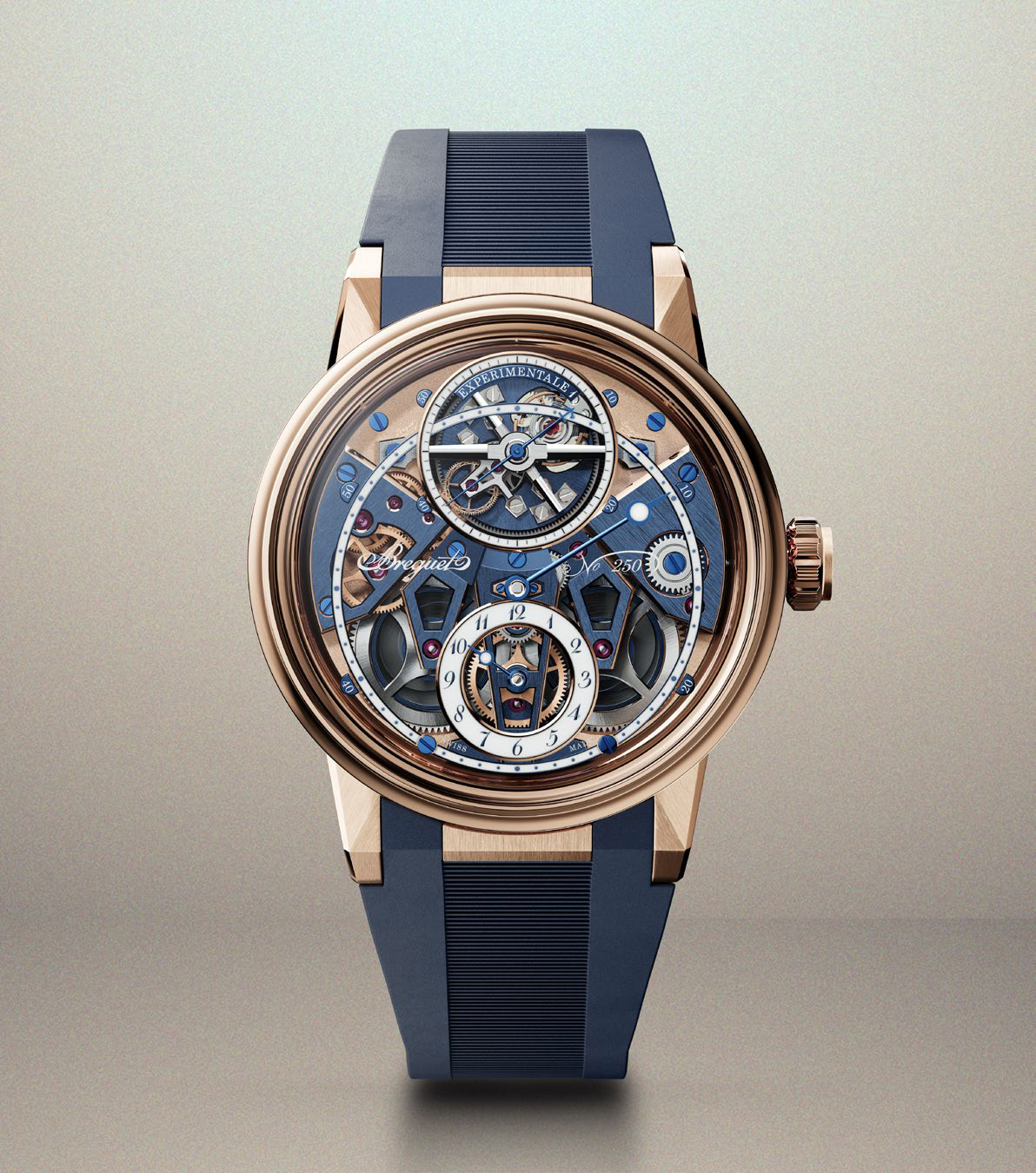
The first model, the Expérimentale 1 , is not just an exercise in engineering style, but a true manifesto, presented as a preview of Breguet watchmaking in the coming years.
A bridge between the past and the avant-garde
The choice to place the new creation within the Marine collection is no coincidence. In 1814, Abraham-Louis Breguet was appointed Horologist to the French Royal Navy, an honor that cemented his role as a scientific master of timekeeping. The Expérimentale 1 pays homage to that tradition by reviving the setting of marine chronometers, specifically the 3448, from which it inherits the regulator layout and the pursuit of symmetry.

The regulator structure – hours at 6 o’clock, off-center minutes and seconds on the tourbillon cage – reflects a functional approach, typical of timepieces designed to ensure maximum readability in operational contexts.

It is also a clear reference to the Breguet 1747 model, also of the regulator type, created in 1997 for the 250th anniversary of the birth of A.-L. Breguet. The Expérimentale 1 takes up this legacy and takes it beyond any traditional aesthetic reference.
The quest for precision: beyond the limits of the traditional tourbillon
The starting point of the Expérimentale 1 project is the ambition to reach a new level of precision. To do so, Breguet chose to simultaneously address three obstacles familiar to anyone working with fine watchmaking: the loss of force in the barrel during unwinding , the variations caused by different positions relative to gravity, and the backlash generated by everyday shocks .

Relying on the tourbillon alone would not have been enough. This is why the Maison combined the rotating cage with a completely redesigned regulating system, based on two extraordinary elements: a record-breaking oscillation frequency for a wrist tourbillon and a new constant-force magnetic escapement.
10 Hz: A speed that changes the rules
The tourbillon's frequency reaches 10 Hz , or 72.000 vibrations per hour. This value places this watch outside the usual range of mechanical tourbillons, almost all of which are set at 2,5 or 4 Hz. The higher the frequency, the faster the balance wheel recovers its amplitude after a shock and the smaller the irregularities in its rate become.

In a tourbillon, which already requires complex energy transitions, maintaining this speed requires perfectly stable force transmission. Hence the need for the component that defines the identity of the Expérimentale 1.
The constant-force magnetic escapement: the silent revolution
At the heart of the watch is a new magnetic escapement , designed to provide a constant impulse to the balance without mechanical contact. Two wheels equipped with magnetic tracks and a magnetic pallet fork work together to create a stable energy flow, independent of variations in the torque transmitted by the barrel.

During the impulse, a dedicated element blocks the escape wheel, isolating it from the rest of the time train. The balance thus always receives the same amount of energy, a necessary condition for ensuring smooth operation at such high frequencies. This approach reduces friction, eliminates the need for lubrication, and limits wear: a radical concept that opens up new horizons for mechanical watchmaking.

The result is a certified precision of ±1 second per day , a value rarely associated with a tourbillon and made possible precisely by the control of magnetic energy.
Movement and materials: a balance between engineering and transparency
The movement, caliber 7250, is built entirely on an 18-karat Breguet gold plate and bridges , a rare detail that only another brand like FP Journe has been able to offer. Its architecture, fully visible through the sapphire dial, features an angular, three-dimensional geometry that breaks with the Maison's traditional language while remaining rooted in its savoir-faire.

The tourbillon cage, crafted from titanium and comprising seventy-four components for a total weight of just 0,60 grams, dominates the upper part of the dial and marks the seconds. Supporting it is an ALD-treated blue gold plate engraved with the Expérimentale 1 , a sort of signature placed to watch over the entire movement.

The double barrel in series, with four springs arranged on two superimposed levels and separated by a sapphire spacer, ensures a power reserve of 72 hours, despite the enormous energy requirements of the high-frequency tourbillon.
A Marine case, reinterpreted in a contemporary key
18-karat Breguet gold shapes the 43,5 mm case, which retains the codes of the Marine collection but interprets them with a new sensibility. The caseband features a double manual finish, while the applied lugs alternate polished, sandblasted, and satin-finished surfaces with ALD-treated blue inserts.

The tool-free interchangeable blue rubber strap reinforces the technical nature of the timepiece, which combines elegance and robustness. All the displays are luminescent, a feature that connects the model to the line's instrumental vocation.
Why the Experimentale 1 is the future of Breguet
Beyond its technical content, the Expérimentale 1 introduces a new interpretation of the Maison's role in the watchmaking landscape. If the tourbillon was, in the early 19th century, an ingenious response to the scientific demands of time, this new model represents an equally visionary response to contemporary challenges: energy stability, shock resistance, chronometric precision, and long-term mechanical sustainability.
The Expérimentale collection is therefore not a simple container, but an open construction site, destined to influence the future evolution of the brand.


