


From the extremely rare 1920 Tank to the Crash, passing through the Santos and the Tortue: Cartier opens the doors of its Geneva boutique to showcase over a century of creativity, design and watchmaking savoir-faire.
Throughout the history of watchmaking, numerous watchmaking houses have built their identity around mechanics, precision, or complications. Cartier has followed a different path, making form a fundamental element of its creative expression. This approach, over the course of over a century, has given rise to some of the most recognizable watches in history, capable of transcending eras and changing tastes without losing their identity.
It is precisely this heritage that is the protagonist of Watchmaker of Shapes, Master of Crafts , the exhibition organised by Cartier in the boutique at 35 Rue du Rhône, Geneva, which brings together 22 historic timepieces belonging to the Cartier Collection.

The exhibition, open until November 14, 2026, traces the evolution of the Maison's aesthetic language through creations spanning the early 20th century to 2019. The journey also celebrates the historic bond between Cartier and Switzerland, a fundamental element of its watchmaking identity.
Form as Identity: From Santos to Crash
From its very first creations, Cartier has demonstrated a particular ability to interpret the wristwatch not only as an instrument for measuring time, but as a design object.
In 1904, Louis Cartier created a watch with a square case and rounded corners for Brazilian aviator Alberto Santos-Dumont, destined to become the famous Santos. It was an innovative design for an era when pocket watches were still the most common form of wristwatch among men.
In the following years, the Maison would continue to experiment with new geometries, giving birth to the Tonneau in 1906, the Tortue in 1912 and the Tank, designed in 1917 and introduced commercially at the end of 1919. Different models, united by one characteristic: the ability to be recognisable through their silhouette alone.

The same creative principle would guide the birth of watches such as the Cloche, with its distinctive bell-shaped case, and the Crash, presented in London in 1967, probably one of the most daring and unconventional interpretations of the wristwatch.
The Geneva exhibition brings together some of these historic forms, demonstrating how Cartier has transformed a seemingly simple element like the geometry of the case into an authentic aesthetic language.
A very rare Cartier Tank from 1920
Among the 22 watches on display, one of the most significant pieces is undoubtedly a Cartier Tank dating back to 1920 , belonging to the very first generations of the model. Its importance is linked not only to its rarity, but above all to its chronological proximity to the birth of one of the most influential watchmaking designs of the twentieth century.
An interesting detail concerns its name. The first pieces were known simply as Tank: the Tank Normale designation would be introduced later, as the family expanded through numerous interpretations. Alongside this piece, the selection includes other timepieces representative of the Maison's origins, including a 1926 Santos crafted in yellow and rose gold.

Observing these creations more than a century after their creation allows us to understand a particularly interesting aspect of Cartier's history: the surprising contemporaneity of forms conceived in an aesthetic and cultural context profoundly different from the current one.
The Cartier Collection: Preserving History to Interpret the Future
One of the most interesting aspects of the exhibition concerns the provenance of the watches presented.
All 22 timepieces belong to the Cartier Collection, the historic collection established by the Maison in 1983 with the aim of preserving, documenting, and showcasing its creative heritage. Today, the collection comprises over 3.500 pieces, including watches, jewelry, and precious objects . Approximately 1.350 are wristwatches, pocket watches, table watches, and other types of timepieces, including nearly 1.000 wristwatches.

Leading this conservation effort is Pascale Lepeu, director of the Cartier Collection, who joined the project in 1993 and became collection manager in 2003.
Her work isn't limited to the acquisition of particularly rare specimens. An equally important role is played by the analysis of historical archives, which allow her to reconstruct an object's provenance, determine its production period, and identify any modifications that may have occurred over the years.
For a Maison like Cartier, whose heritage includes numerous variations of historic models, this activity takes on a particular significance.

The Cartier Collection therefore does not represent a simple archive of objects from the past, but a tool through which the Maison continues to study and enhance its identity.
Cartier Privé: A Dialogue Between Past and Present
The exhibition coincides with another significant moment for the Maison: the tenth chapter of Cartier Privé, the collection dedicated to the contemporary reinterpretation of the great classics of its history.
Over the years, Cartier Privé has brought back to the attention of enthusiasts models such as the Tank Cintrée, the Tonneau, the Tank Asymétrique, the Cloche, the Tank Chinoise, the Tank Normale, the Tortue, and the Tank à Guichets. This project is particularly interesting because it demonstrates how historical heritage can become the starting point for new interpretations, without necessarily altering the original identity of a timepiece.
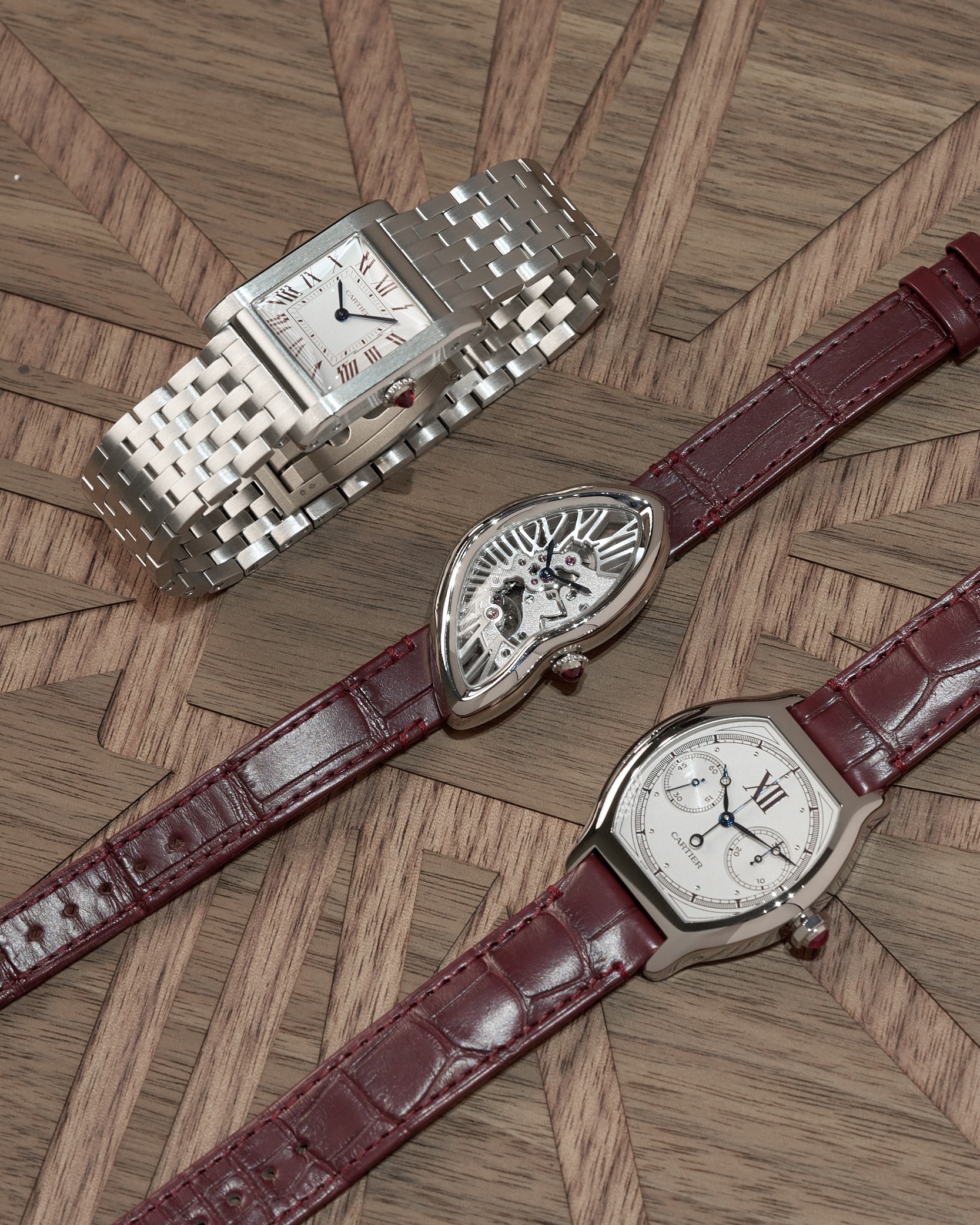
For the tenth installment, Cartier returns to explore three emblematic forms: the Tank Normale, the Tortue Monopusher Chronograph, and the Crash Skeleton , all interpreted in platinum and featuring burgundy details. Platinum, a material historically linked to Cartier creations, represents a further element of continuity with the Maison's past, while the use of complex movements and skeletonized architectures allows for aesthetic research to be combined with a more specifically mechanical dimension.
In this context, the 2019 Tonneau Skeleton and the 2018 Tank Cintrée Skeleton, both made of platinum and present in the exhibition, are also particularly representative.

Two creations that demonstrate how the movement can be conceived in close relation to the geometry of the case, to the point of becoming an integral part of the aesthetic architecture of the watch.
A heritage that continues to evolve
Watchmaker of Shapes, Master of Crafts offers an opportunity to reflect on one of the most distinctive aspects of Cartier watchmaking: its ability to evolve without abandoning a consolidated aesthetic language.
While today the industry is often focused on introducing new complications, materials, or technical solutions, the Maison's history demonstrates how form can also be one of the most enduring expressions of innovation.

The striking relevance of models designed over a century ago, such as the Tank or the Santos, is perhaps the most striking demonstration of this. The Geneva exhibition therefore does more than simply celebrate 22 historic watches. Rather, it illustrates a creative philosophy in which design, tradition, and technology have contributed to building an instantly recognizable identity.
Watchmaker of Shapes, Master of Crafts
Cartier Boutique, 35 Rue du Rhône, Geneva
From 7 October 2026 — indicated deadline: 14 November 2026
Access upon registration.


